

Planting Scheme
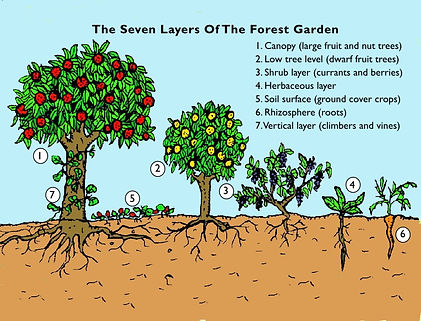
Image by Graham Burnett
Below you will find details of the planting schemes for plot 163b only. The technique used on this allotment is the Food Forest system. This is a polyculture, perennial based system, mimicking the natural layers of a forest, or woodland. The idea is to use a system Nature uses well, replacing non edible species withe edible ones. This method uses growing space more effectively than the traditional, long, rectangular beds which are common on allotments, taking up more space.
By planting in this way, more food can be integrated into the space. Not all of the layers have been used. Where possible I have included information on the functions that each plant offers, and why it has been included in the design.
Using perennial plants, helps to design a low maintenance way of growing, applying the no dig method which helps to sequester carbon in the ground. This technique helps to keep the ground covered, reducing evaporation and retaining nutrients and moisture. The plants in each bed are placed together as a guild.
Maintenance of beds
I use the sheet mulching method to control 'weeds'. It also helps to keep the ground cool in the summer and warm in the winter. It helps to build fertility too, as the worms take the material down into the ground.
The ground is prepared by cutting any 'unwanted' plants down to ground level, such as grass or comfrey. Cardboard and another organic material, such as compost or straw, is then placed on top. This is then watered to keep it moist. Occasionally I use lasagna layering. This is sheet mulching done twice.
Plants can be planted immediately into either single sheet mulching or the lasagna layering. Alternatively, this is a good technique to use to manage your allotment, or garden when first taking them on.
Bed 1
Medlar - sub canopy
Sedum - herbaceous groundcover
Strawberry - ground cover
Lemon balm - ground cover. Mineral accumulator
Purple Loosestrife - herbaceous layer
Bed 2
Cytisus/Broom - Shrub layer/nitrogen fixing
Lemon balm - herbaceous ground cover
Fennel - herbaceous herb
Onions - Annual
Yarrow - pollinator attractant, soil building & herbal tea
White campion - pollinators attractant
Bed 3
Autumn Olive - Shrub layer. Berries. Fertiliser
Amelanchier alnifolia/saskatoon - Shrub layer. Berries
Perennial wildflower- Herbaceous ground cover
Austurian Tree Cabbage - perennial leaves.
Salad burnet - Ground cover. Salad.
Garlic chives- Vegetable
Oregano - Ground cover. Herb
Compost bin in situ for soil fertility, shade and structure for climbing plants.
Bed 4
Siberian current - Shrub layer. Fruit
Pear - Sub canopy. Fruit
Asparagus - Herbaceous ground cover. Vegetable.
Courgette - Annual. Vegetable
Chard - Biennial. Harvest leaves
Climbing beans - vegetable
Compost bin in situ to build fertility, for shade and structure for climbing plants.
Bed 5
-
Ginkgo - Sub canopy
-
Marshmallow - Herbaceous ground cover. root used for making soups. Flowers for pollinators
-
Squash - Ground cover. Annual. Vegetable
-
Alpine Strawberries - Ground cover
-
Lemon balm - Mineral accumulator. Herbal tea for depression.
-
Corn - Annual. Vegetable
-
Rhubard - Herbaceous perennial. Ground cover. Fruit. Leaves for making dye mordant and mulching.
-
Birdbath for birds and bees.
Bed 6
-
Lavendar- shrub layer
-
Day lilly - herbaceous ground cover (flower harvested)
-
Alpine Strawberries - ground cover
-
Purple brussel sprouts - Vegetable
-
Tree Spinach/Magenta Spreen. Volunteer. Good for making pesto. Salad. Mulching.
Bed 7
-
Redcurrants- Shrub layer. Fruit
-
Blackcurrants - Shrub layer. Fruit
-
Raspberry - Shrub layer. Fruit
-
Soapwort - Ground cover. Shampoo or hand soap for delicate skin and fabrics.
-
Compost bin in situ to build fertility,for shade and structure for climbing plants
This bed is being redesigned. Several plants were lost in the severe cold weather of 2023.
Bed 8
-
Blackcurrant - Shrub layer. Berries
-
Ice plant - Herbaceous ground cover. Edible leaves. Flowers excellent for bees
-
Austrian Tree Cabbage - Perennial cabbage
-
Soapwort - Herbaceous ground cover. Leaves and flowers make liquid soap.
Bed 9
-
Apple tree - Sub canopy. Edible fruit
-
Cytisus - Shrub layer- Edible flowers.Nitrogen fixing
-
Gooseberry - Shrub layer. edible fruit
-
Aquileiga - Herbaceous layer. Edible flowers
-
Rhubard - Herbaceous layer. Fruit
-
Soapwort - Herbaceous layer. Good for soap
-
Ice plant - Herbaceous layer. Edible leaves
-
Vinca Major - Ground cover- (This plant doesn't fit the design for this bed and is slowly being removed.)
-
Dandelions - All parts are edible. Great for native bees. My favourite plant!
Compost bin in situ to build fertility. This bin has a closed top and bottom, unlike the other compost bins. Holes have been drilled into the bottom to allow the liquid to flow into the bed for fertility.
This bin is used for cooked food scraps only.


Additional Existing Elements
Plants such as comfrey, and nettles have been incorporated into the design. These are used for bees, and fertiliser as well as shade. The willow tree is pollarded occasionally. The wood is used for fire wood, making poles and fencing, and the branches are used for making willow tea and to add to the liquid feed bucket, along with comfrey, nettles and other plants. It also provides shade to sit under, and nectar for honey bees and other insects.
Disclaimer:
I do not take responsibility for any ill effects you may have from trying any of the plants, should you eat them or put them on your skin. I have several years experience of dealing with plants such as these, and can only vouch for this experience and my training & skills in this area.
I am not a herbalist or a horticulturist. I am a Permaculture designer and educator and the above information is used as part of a Permaculture design, and as a LAND demonstration project with the Permaculture Association UK.